It's a question most marketers struggle to find an answer to: If someone searches on Google, ChatGPT, or Perplexity for your industry, who is mentioned?
Traditionally, competitor analysis included collecting gaps and backlinks and finding out where your competitor stands in the blue ranking of search results. This is important. However, today a large share of searches is ending with a piece of text provided by AI in the first position. Those companies that are being mentioned in AI-provided answers are getting all the credit.
This is what AI search competitor analysis is all about. This is the method of discovering which competitors are recommended, quoted, and described by AI tools and figuring out why. Down below, we will explain what the whole process looks like, why the stats say you need to pay attention to it, and provide you with a step-by-step process of how to do it.
What AI Search Competitor Analysis Actually Means
Competitor analysis of AI search is the activity of monitoring the frequency of mentions, description and sources of references that AI uses to describe your competitors. Rather than asking "who is #1 in this keyword," you are asking "who is mentioned, who is cited, and who is recommended when a customer asks a real question."
It seems like a slight change, but there are actually several changes that come with making this shift:
The unit is a prompt, not a keyword. People type full questions into AI tools, like "what's the best payroll software for a 20 person company." Your tracking needs to reflect that.
Mentions and citations are two separate wins. A brand can be named in the answer without its site being linked, or linked without being named. Both matter, and you should track them separately.
Your competitors aren't only your competitors. In AI answers, you're often up against review sites, forums, YouTube videos, and publishers. If a listicle on someone else's site is the source the AI trusts, that site is a competitor for visibility even if it sells nothing.
Answers vary. Ask the same question twice and you might get a different set of brands. That means one screenshot proves very little. You need repeated checks over time.
Traditional SEO competitor research tells you who owns the page. AI search competitor analysis tells you who owns the answer.
Why This Matters Right Now
If you're wondering whether AI answers really move the needle, the research from the past year is pretty clear.
A randomized field experiment from researchers at the Indian School of Business and Carnegie Mellon, covered by Search Engine Journal, found that Google's AI Overviews cut organic clicks by 38% on the queries where they appeared. Zero-click searches jumped from 54% to 72% in those cases. AI Overviews showed up on 42% of the queries participants ran. That's not a fringe feature anymore.
However, Ahrefs also approached this problem from another perspective and got to a very similar conclusion. After analyzing 300,000 keywords with the help of Google Search Console statistics, the company discovered that the highest ranked page gets approximately 58% fewer clicks when there is an AI Overview in place. In April 2025, the same study gave the drop 34.5%. In simple terms, being the top-ranked page is not what it used to be, when someone else controls the answer above you.
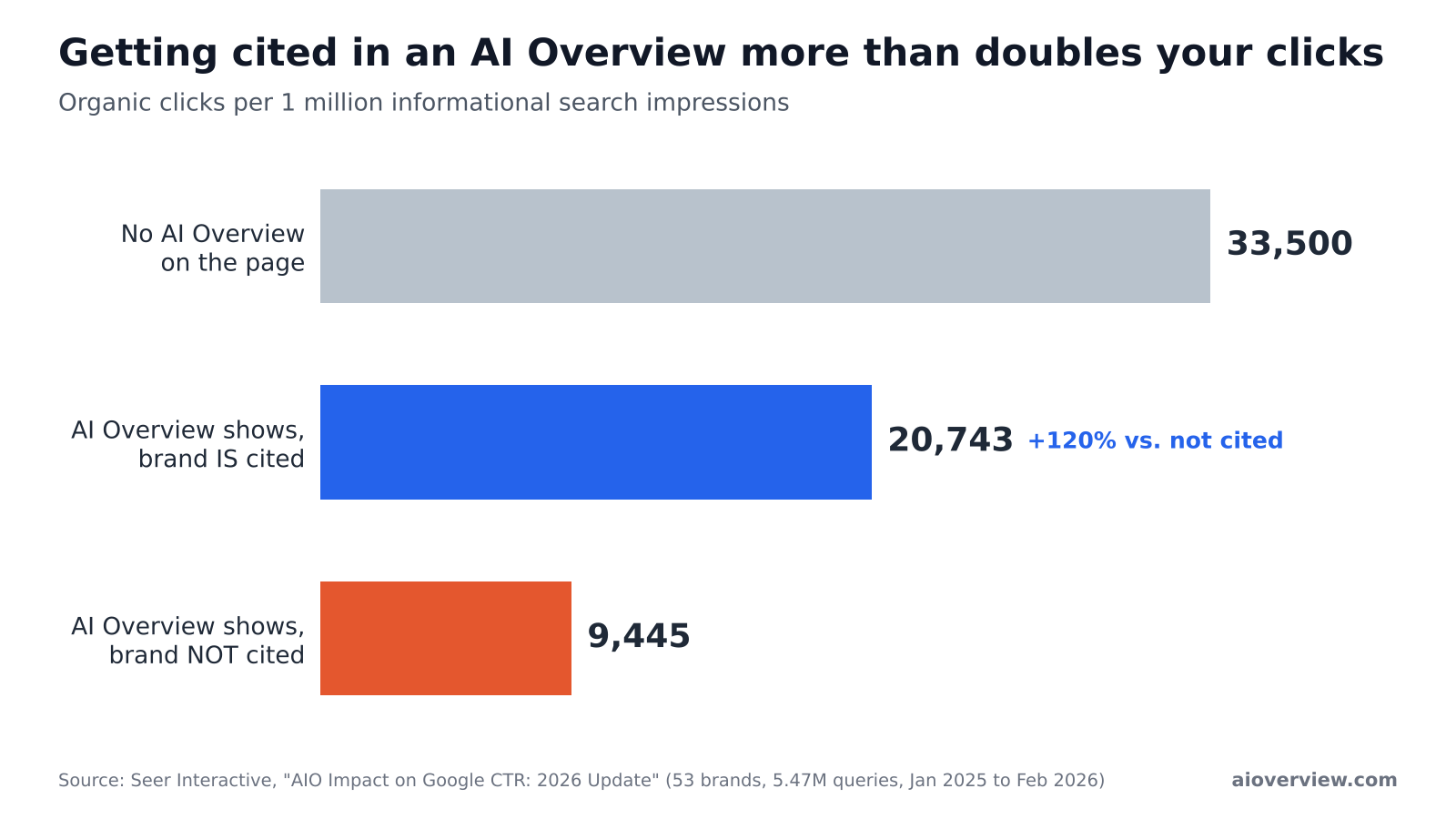
The more interesting finding, at least for competitor analysis, came from Seer Interactive. Their 2026 AIO CTR study tracked 53 brands, 5.47 million queries, and 2.43 billion organic impressions. When an AI Overview appeared and a brand was cited in it, that brand earned about 120% more organic clicks per impression than brands on the same results page that weren't cited. Put in raw numbers, for every million informational impressions, a cited brand got roughly 20,743 clicks while an uncited one got about 9,445.
The AI Overview by itself is not the whole picture either. If you or your competitor are in the AI Overview is what determines everything. According to Seer, "comparison queries" (the old "X vs Y") yielded an AI Overview 95.4% of the time, while "question style queries" yielded one 85.9% of the time. This is precisely how a customer would evaluate choices.
In other words: the fight for consideration is taking place within the AI response, and if you don't know who is winning the battle, you are shooting blind.
How to Run an AI Search Competitor Analysis, Step by Step

You don't need a giant budget to start. You need a clear list of questions, a consistent way of checking answers, and a spreadsheet you actually keep updated.
1. Build a prompt list that sounds like your buyers
Start with 30 to 50 prompts. Pull them from sales call notes, support tickets, "People Also Ask" boxes, and the questions your customers ask before they buy. Mix in a few types:
Category questions: "What are the best tools for X?"
Comparison questions: "Is Brand A better than Brand B?"
Problem questions: "How do I fix X without hiring someone?"
Brand questions: "Is [your brand] any good?" and the same for each competitor
Since comparison and question searches trigger AI answers most often, give them extra weight.
2. Pick the platforms that matter for your audience
Start with at least checking Google AI Overviews and AI Mode, ChatGPT, Perplexity, and Gemini. For developer customers, throw in whatever else they use. Not all platforms need the same level of effort, so consider where your target audience spends their time..
3. Record who shows up, and how
For each prompt and platform, log the same things every time:
Which brands are mentioned, and in what order
Which domains are cited or linked
Whether the mention is positive, neutral, or comes with a caveat
Any wrong or outdated info about you or a competitor
Run each prompt more than once. AI answers shift, and you want a pattern, not a fluke.
4. Calculate share of voice
Share of voice is very easy to understand: of all the prompts that you have, what percentage of responses will talk about each brand? In case your competition gets a 60% response rate while yours is only 15%, then you know where the problem lies. Keep track of mentions and citations separately.
5. Dig into the sources
And this is the stage everyone skips, but this one is the most valuable one. Check which pages the AI uses as references when recommending its competitors. Is it the official guides of the competitor? Some round-up at a major review site? Something from Reddit or YouTube? All these are the reasons why the AI "thinks" the way it does. They also provide you with very precise information where you should be.
And do not presume that all these sources are the same pages that show up in the first 10 results of classic search as well. As reported by Search Engine Journal, there was an analysis performed by Ahrefs of 863 thousand keywords and 4 million AI Overview URLs, revealing that just 38% of referenced pages also showed up in the top 10 of the search for the same query. And nearly a third of them did not rank even in the top 100. YouTube appeared to be the most referenced domain in AI Overviews.
6. Find the gaps and rank them
Now sort your findings into buckets. Prompts where no one owns the answer are quick wins. Prompts a competitor dominates need a longer play. Prompts where the AI gets something wrong about you are urgent. Put your effort where the business value and the gap are both big.
7. Repeat on a schedule
Re-run your prompt set monthly at least. AI answers change as models update and new content gets published, so a one-time audit goes stale fast.
Turning What You Find Into Action

An analysis is only worth something if it changes what you do next. Here's where the findings usually point.
Write the page the AI wishes existed. If a competitor keeps getting cited for a question, read their page closely. Then make something clearer, more specific, and more current. Answer the question in the first couple of sentences, back it with real data or examples, and cover the follow-up questions people naturally ask next.
Show up where the AI is already looking. When your source analysis shows the AI leaning on a particular review site, forum, or publication, that's your outreach list. Get listed, get reviewed, join the conversation honestly, or pitch a guest piece. Earning a mention on a source the AI already trusts can be faster than waiting for your own site to get picked.
Fix how you're described. If AI tools get your pricing, features, or positioning wrong, update your own site first so the facts are easy to find and hard to misread. Then check your profiles on third-party sites, since outdated listings tend to stick around in AI answers.
Don't abandon the queries AI doesn't touch. Seer's data showed organic click-through on informational queries without an AI Overview actually improved over 2025, from 2.93% to 3.97%. Those searches are still worth owning, and your competitors may be ignoring them while they chase AI visibility.
Mistakes We See All the Time
Treating one screenshot as proof. A single answer tells you almost nothing. Run prompts multiple times and across platforms before drawing conclusions.
Only tracking direct competitors. The site getting cited in your category might be a publisher or a forum. If you leave them out, you'll miss half the picture.
Judging success by CTR alone. Seer found that one group of cited brands saw CTR drop sharply in late 2025, but clicks stayed flat while impressions more than doubled. More citations, same clicks. Always look at clicks and impressions separately.
Using made-up prompts. If your prompt list reads like a keyword tool export, it won't match how people actually talk to AI. Use real customer language.
Doing it once. AI answers move. A quarterly or monthly rhythm beats a one-off deep dive every time.
The Bottom Line
Search didn't go away; it just had a new entry point. If the AI-powered answer is sitting on top of the results page, the brands mentioned within it receive the trust and clicks, and everything else is left to fight over the scraps.
AI-powered search competitor analysis offers you a method to understand this new reality. Do things on a small scale: 30 prompts, four platforms, and one spreadsheet. Identify those brands who are winning the answers in your category and the sources that are powering their success. Then go claim your spot. This is the time when it is still relatively easy.
Sources
Southern, Matt G. "Study Confirms Google AI Overviews Cut Organic Clicks 38%." Search Engine Journal, April 27, 2026. https://www.searchenginejournal.com/ai-overviews-cut-organic-clicks-38-field-study-finds/573145/
McDonald, Tracy, Hannah Cooley, and Marketa Williams. "AIO Impact on Google CTR: 2026 Update." Seer Interactive, April 24, 2026. https://www.seerinteractive.com/insights/aio-impact-on-google-ctr-2026-update
Law, Ryan. "Update: AI Overviews Reduce Clicks by 58%." Ahrefs, February 4, 2026. https://ahrefs.com/blog/ai-overviews-reduce-clicks-update/
Southern, Matt G. "Google AI Overview Citations From Top-Ranking Pages Drop Sharply." Search Engine Journal, March 2, 2026. https://www.searchenginejournal.com/google-ai-overview-citations-from-top-ranking-pages-drop-sharply/568637/