
Google results used to be the finish line. Now they are just one stop along the way. Tools like ChatGPT, Perplexity, Gemini, and Google AI Overviews pull from the web, synthesize an answer, and decide on their own which sources deserve a citation. That decision is shaped by a different set of rules than classic SEO, and understanding those rules is now essential for anyone who wants their content to show up in an AI generated answer.
This guide breaks down the AI search ranking factors that matter most right now, based on how these systems actually select and cite sources.
AI Search Doesn't Rank Pages, It Selects Passages
Traditional search engines rank entire URLs against a query. AI systems work differently. They evaluate individual chunks of information for meaning and relevance, then stitch the best chunks together into one synthesized answer. A single page might get cited for one paragraph while the rest of the content is ignored entirely.
This is why long, sprawling articles do not automatically win. What wins is a page containing at least one tightly written, self-contained section that fully answers a specific question.
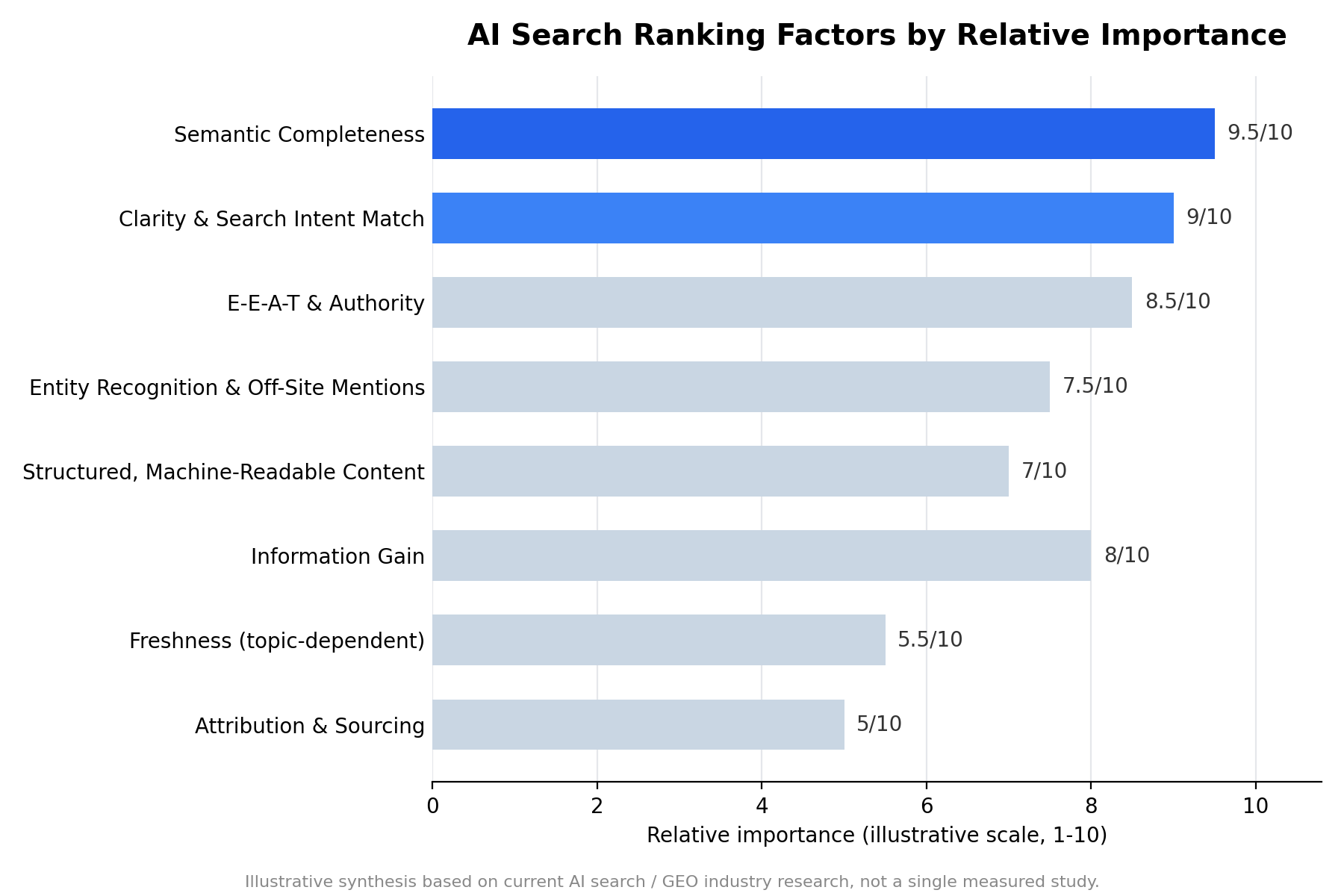
1. Semantic Completeness
This is consistently identified as the single strongest predictor of whether a passage gets cited. Research examining thousands of AI Overview results found that content scoring high on semantic completeness was several times more likely to be selected, with the sweet spot for a self-contained answer landing in the 134 to 167 word range. The passage needs to fully resolve the question on its own, without requiring the reader to click through or scroll further.
Practical takeaway: write answer-first paragraphs. State the direct answer in the first sentence or two, then support it with detail. Do not bury the answer under three paragraphs of preamble.
2. Clarity and Search Intent Match
AI tools are built to answer questions, not to reward keyword density. If a page does not directly address the intent behind a query, it is unlikely to be surfaced, even when that same page ranks well in traditional organic search. Clarity also affects extraction. Content that is easy to parse, with plain language and a logical structure, gets pulled into answers more often than content that buries its point in jargon or dense phrasing.
Practical takeaway: match your headers and opening sentences to the actual questions people ask, in the language they use to ask them.
3. E-E-A-T and Demonstrated Authority
Experience, Expertise, Authoritativeness, and Trustworthiness remain critical for AI driven ranking systems, and this hasn't gone away with the shift to generative search. AI systems favor sites that show deep expertise in a topic rather than shallow, generic coverage. That means author bios, credentials, first-hand experience, and a track record of covering the subject in depth.
Trust also compounds. Established sites with a long publishing history and consistent citation density tend to outperform newer domains on the same term, even when the newer site's content is arguably better written. If you are a newer site, the workaround is to target narrower, less contested topics where the authority bar is lower, and to build a consistent publishing cadence over time.
4. Entity Recognition and Off-Site Mentions
AI systems do not just match keywords, they map entities. That means your brand, your people, and your products get evaluated based on how they relate to other known concepts across the web, not just on your own site. Brands that rely solely on their own blog, with no third-party mentions, are missing a real lever here.
Interestingly, a meaningful share of the pages most frequently cited by ChatGPT do not rank in Google's top 10 for the same query at all. Earned media mentions and topical depth across multiple sources appear to matter more to these systems than raw backlink volume or keyword density.
Practical takeaway: pursue mentions on reputable third-party sites, industry publications, and forums where your brand and topic get discussed in context, not just linked.
5. Structured, Machine-Readable Content
AI systems need to extract and summarize your content quickly, which rewards a specific kind of formatting: clear headers, short paragraphs, bullet points, and schema markup where relevant. Multimodal pages that pair text with images, video, and structured data have shown a notably higher selection rate than text-only pages covering the same topic.
Schema markup in particular helps AI systems understand what a page is about without having to infer it from unstructured prose, and it is one of the more direct technical levers you can pull.
6. Information Gain
Content that only restates what is already well established elsewhere on the web has little reason to get cited. Systems increasingly favor material that adds something new: original data, a fresh angle, a case study, or a perspective not already covered. Several analyses now identify information gain as the most important ranking factor overall, ahead of more traditional signals like link volume.
Padding does the opposite of what people assume. A shorter article with zero filler consistently performs better than a longer one carrying unnecessary word count, because every irrelevant paragraph dilutes the passage-level relevance AI systems are actually scoring.
7. Freshness, But Only When It's Real
Recency matters less in AI search than it does in traditional search, with one exception: trend-driven or fast-moving topics. For evergreen subjects, an older well-written page can still perform fine. For anything tied to a specific year or a fast-changing field, update frequency matters more, but only if the update actually changes the substance. Simply changing a timestamp without adding new information does not move the needle.
8. Attribution and Sourcing Within Your Own Content

Creative Web Designer planning application and developing template layout, framework for mobile phone. User experience (UX) concept.
By MIND AND I
Content that cites other sources and properly attributes its claims tends to get cited more often itself. This might seem backwards, but it signals to AI systems that the page is well-researched and trustworthy rather than a thin rehash of someone else's work.
Putting It Together
None of these factors work in isolation, and you do not need to optimize for all of them simultaneously. The AI search ranking factors that marketers can most directly influence are the ones worth prioritizing first: writing complete, self-contained answers, matching real search intent, structuring content for easy extraction, and building topical depth both on-site and across the wider web.
The core shift to internalize is this: you are no longer just trying to rank a page. You are trying to get a specific passage selected as trustworthy enough to represent an answer on your behalf. Write with that goal in mind, and the rest of the factors above become much easier to act on.
Sources