
Search behavior has changed faster than most brand strategies have kept up with. ChatGPT now sees more than 900 million weekly active users, and people send billions of messages through it every day. A growing share of those conversations are shopping research, product comparisons, and "what should I use for X" questions that used to happen entirely on Google.
That shift has created a new problem for marketers: your brand can be well known, well ranked, and completely invisible inside an AI answer. This is the core idea behind brand visibility in ChatGPT, and it works differently enough from traditional SEO that most existing playbooks fall short.
What Brand Visibility in ChatGPT Actually Means
ChatGPT brand visibility refers to the chances that your organization will get mentioned, described, and recommended when ChatGPT is asked about something. ChatGPT brand visibility is not about ranking on a particular page. The concept of ChatGPT page one does not exist at all because ChatGPT generates a response that can or cannot include your brand.
As one industry analysis put it, brands used to compete for the click. Now they are competing to be remembered by the model itself, since a user might act on ChatGPT's recommendation without ever visiting your site or seeing your ad.
It is the reason why there has developed a science known as Generative Engine Optimization (GEO). While SEO is all about optimizing your content for rankings and clicks, GEO is concerned with including your brand in the AI-generated results in an accurate way.
Why Traditional SEO Doesn't Transfer Directly
It's tempting to assume that ranking well on Google is enough. It isn't. Research is starting to show just how different the underlying mechanics are.
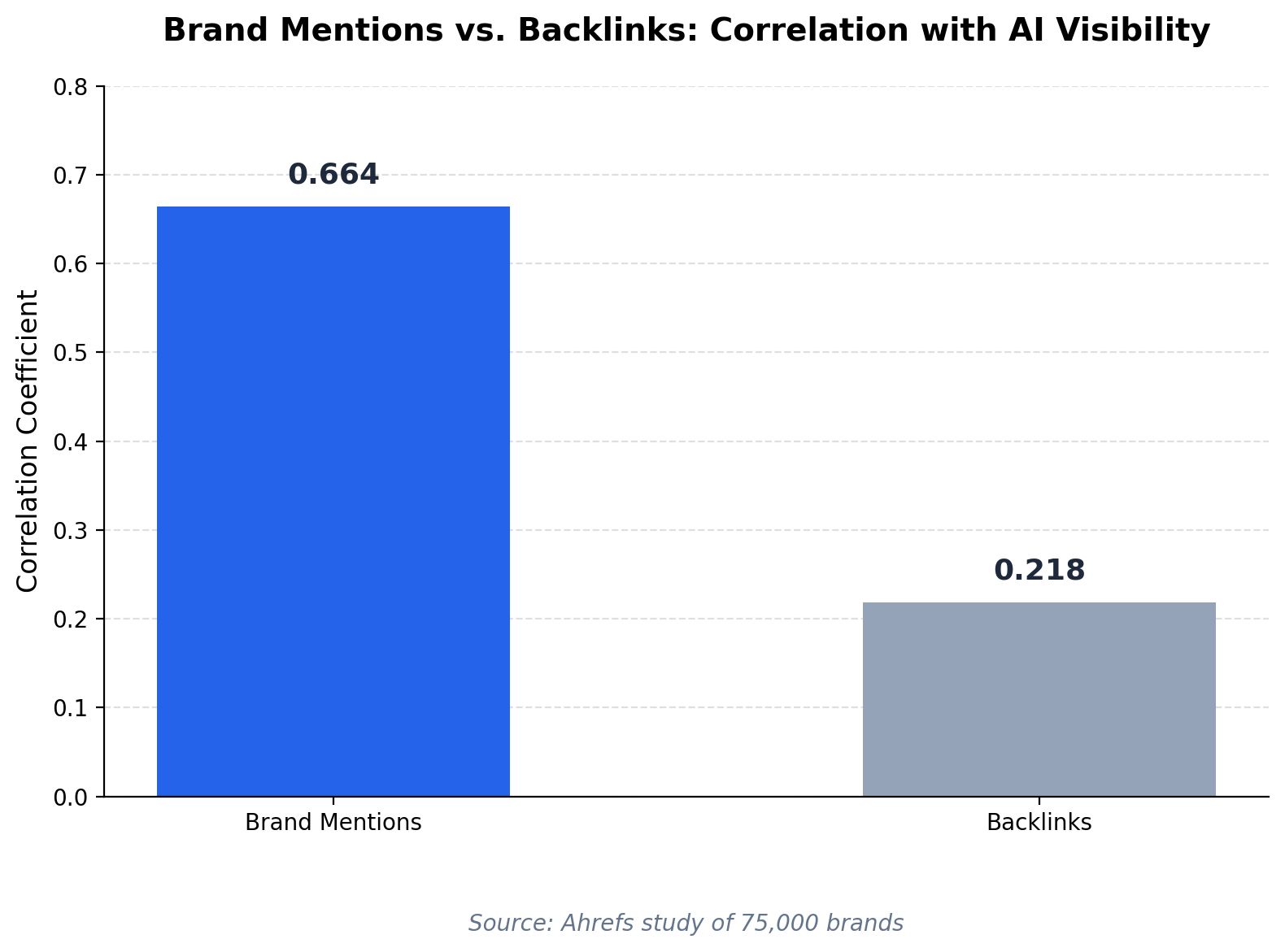
An Ahrefs study of 75,000 brands found that brand mentions across the web correlate far more strongly with AI visibility than backlinks do, with a correlation roughly three times stronger for mentions than for links, based on data referenced in a practical GEO playbook from Omnia. A number of independent studies conducted by Princeton, Georgia Tech, and IIT Delhi have shown that including certain types of statistics into content can significantly increase its chances of being used in AI generated answers.
ChatGPT is also far more selective than a typical search engine. Analysis cited by Verse Odin found that ChatGPT cites only around 15 percent of the pages it actually retrieves during a live search, meaning getting crawled and retrieved is just the first hurdle, not the finish line.
One of the most crucial structural considerations: ChatGPT exhibits a high preference for third-party, earned content as compared to self-produced content by a brand. This structural preference was revealed in a research paper by the University of Toronto regarding the optimization of generative engines, while industry statistics indicate that around two-thirds of references are from third-party sources rather than brand pages, per Verse Odin. If your visibility approach relies heavily on your own blog and product pages, then that’s already a structural weakness regardless of the quality of your content.
How ChatGPT Decides What to Mention
There are some mechanisms that have more weight to them than you may think when it comes to determining whether or not your brand makes an appearance.
Query intent has more value than topic. The probability of commercial intent prompts like comparison queries, "best of" lists, pricing questions and reviews is much higher than that of pure information queries, according to research conducted by Verse Odin. If your brand creates only evergreen educational articles, it might not show up at the moment that really counts.
Conversation position is important. A research study of hundreds of thousands of ChatGPT conversations revealed that there is a very high probability of a user’s initial question triggering a citation producing search as opposed to any follow-up question asked further down in the same conversation.
Retrieval and crawlability come first. Dageno's guide on ChatGPT visibility notes that citation-ready source pages need to be clear, crawlable, and easy for AI systems to extract and summarize, not just optimized for human readers or traditional rankings.
Cross-platform overlap is low. According to Dageno's broader analysis, citation patterns on ChatGPT share only about 10 to 11 percent overlap with Google's AI features and Perplexity. Performing well on one AI platform does not guarantee you'll perform well on another, which means visibility work has to be platform aware rather than generic.
Practical Steps to Improve Brand Visibility in ChatGPT

AI chatbots is the process of artificial intelligence between systems and human beings. In other words, AI chatbot is a virtual customer service that can actively interact with the world
1. Audit your current AI presence.
Ask ChatGPT eight to ten questions that a real customer would ask, and note whether your brand appears, how it's described, and whether the facts are correct. This baseline, recommended in Airfleet's guide for B2B marketing leaders, tells you where you're starting from before you change anything.
2. Build clear, consistent entity definitions.
ChatGPT needs to recognize what your brand is and what it does without ambiguity. Accuracast's research on international visibility stresses building clear entity definitions and consistent messaging across every market and every page, since inconsistency in how you describe your own product makes it harder for the model to represent you accurately.
3. Earn third-party coverage, don't just publish your own.
Considering that earned mentions favor the most, PR, analysts’ relationship, comparatives, reviews, and independent publications become increasingly important for AI more than SEO ever was. Having one’s brand mentioned exclusively on their own domain means a very difficult task.
4. Add specific, citable facts.
Vagueness in marketing language is easily ignorable. Facts, figures, prices, and specifics will always get incorporated into the answer, which is what the study from Princeton and Georgia Tech suggests above.
5. Structure content for direct answers.
Write in a way that answers the likely question plainly and early, rather than burying the useful information under long introductions. This also happens to be one of the core habits Verse Odin recommends for improving AI visibility consistently over time: structure content for direct answers, earn genuine third-party mentions, and keep facts consistent everywhere they appear.
6. Prioritize commercial-intent content.
As comparison and “best” type questions are more likely to elicit live search, make sure you have some content where you discuss your differences from other options. Don’t just publish top of funnel education content.
7. Track and measure instead of guessing.
GEO platforms and manual prompt audits both work, but the important part is doing this regularly. G2 research found that half of B2B buyers already start their purchase journey inside an AI chatbot rather than a traditional search engine, referenced in Omnia's practical playbook for 2026, which makes ongoing tracking a real business priority rather than a nice to have.
Common Mistakes Brands Make
Treating GEO as a rebrand of old SEO tactics rather than a genuinely different discipline
Relying almost entirely on owned content, ignoring the third-party bias in how ChatGPT sources answers
Optimizing only for informational queries and ignoring commercial intent prompts
Never actually testing what ChatGPT says about the brand today
Assuming visibility on one AI platform transfers automatically to another
The Bottom Line
Visibility in ChatGPT is quantifiable, manipulatable, and ever more correlated with actual commercial success despite its not being an example of conventional search ranking. The companies that will succeed in the coming years of AI-fueled discovery are those companies that have come to understand the necessity of treating visibility in this context as an independent discipline, establishing entity signals, gaining third party mentions, and measuring their presence in AI answers just as they once measured search rankings.
Sources
Accuracast: How to Increase International Brand Visibility in ChatGPT
Airfleet: Brand Visibility in ChatGPT, How B2B CMOs Influence What LLMs Recommend
Dageno AI: ChatGPT Brand Visibility, Measurement, and Optimization Guide
Verse Odin: How to Improve Your Brand's Visibility on ChatGPT
Verse Odin: What Strategies Actually Improve Brand Visibility in ChatGPT