
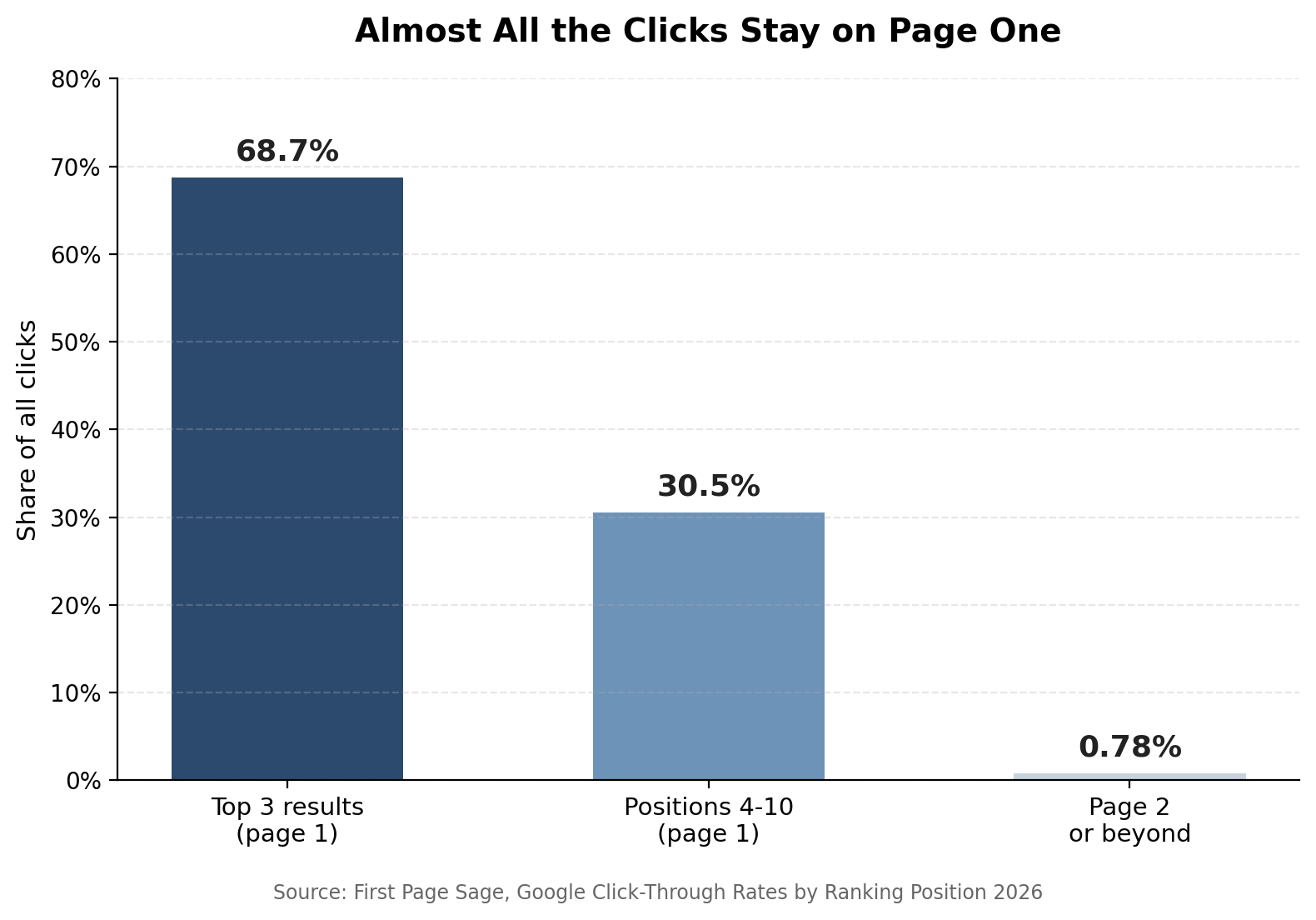
The reason why getting the first page on Google from SEO is the objective of all efforts towards search engine optimization is because most of the clicks happen to be received by the few websites that are ranked at the top. Everything that appears past the second page is left behind by all other website traffic. When working towards SEO, achieving first page ranking is where it’s at.
This guide from Aioverview.com breaks down what it actually takes to earn and hold a first page spot, based on how Google itself describes its ranking process.
Why First Page Rankings Are Worth the Effort
The gap between page one and page two is not small. Research from First Page Sage shows that the top three organic results alone capture the majority of clicks on a typical search, and click share drops off sharply from there. A separate 2026 statistics roundup from Instant Press notes that organic search still drives roughly 53% of all website traffic, even with Google handling an estimated 8.5 billion searches a day. With that much competition for a limited number of spots, a page that never reaches page one is, for practical purposes, invisible to most searchers.
Start With Search Intent, Not Just Keywords
Search engine optimization used to be treated as a keyword-matching exercise, but Google's systems have moved well past that. According to Google's own How Search Works documentation, relevancy is determined by hundreds of factors, including the words in a query, the usability of a page, and how well the content actually satisfies what the searcher is looking for. Before penning down anything, it is always better to question oneself about what people are looking for when entering such keywords: definition, comparison, instruction, or a shopping destination. The content that is in accordance with the intent of the user always performs better than the content in accordance with the keywords.
Build Content That Demonstrates Real Expertise
Google's guidance on creating helpful, reliable, people-first content lays out what its systems look for: experience, expertise, authoritativeness, and trustworthiness, often shortened to E-E-A-T. In practice, this means original insight beats a rehash of what already ranks. A page that reflects firsthand knowledge, includes specific detail, and answers a topic thoroughly gives Google a much stronger signal than a thin, generic overview of the same subject.
Fix the Technical Foundation
Great content on a slow, clunky site rarely earns a first page spot. Google's guide to its ranking systems explains that its systems evaluate page experience alongside content quality, including how quickly a page loads and how usable it is on mobile devices. A technical audit that checks load speed, mobile responsiveness, and basic crawlability issues is often the fastest way to remove hidden barriers that are quietly holding a page back.
Earn Real Authority Through Links
Backlinks remain one of the clearest trust signals a page can have. A 2026 SEO statistics review from Loopex Digital found that 92.3% of the top 100 ranking domains had at least one backlink, and that more than half of otherwise qualified sites without a single backlink never reached the first page at all.Earning links naturally, through original research, genuinely useful resources, or coverage from other credible sites, still does more for long-term rankings than any shortcut. It is a pattern we see confirmed again and again in the search visibility work we do at Aioverview.com.

business, people and team work concept - team of startuppers with gadgets and papers working at office table
By Syda Productions
Keep Refreshing What You Publish
First page ranking is not a final destination. The content which was detailed a year ago could easily be surpassed by other competing sites who write about the topic at hand and are able to do it better and more extensively. It makes sense to go back to an old piece of content, refresh and add to it rather than create a new one from scratch.
The Bottom Line
SEO for the first page really boils down to a tried-and-true recipe: figure out what the searcher really wants, create something that shows you know what you’re talking about, eliminate any technical barriers, and develop true authority. There is no substitute, but companies that keep doing all four will find they retain their first page status as Google keeps changing its results page.
At Aioverview.com, this is the same approach we bring to every client's search visibility, treating a first page ranking as an ongoing discipline rather than a one time project.
Sources
First Page Sage, "Google Click-Through Rates (CTRs) by Ranking Position in 2026"
Google Search Central, "In-Depth Guide to How Google Search Works"
Google Search Central, "Creating Helpful, Reliable, People-First Content"
Google Search Central, "A Guide to Google Search Ranking Systems"