
Search engines no longer match terms; today, they try to understand your content, its meaning, its audience, and its relation to all other information on the subject matter. This is precisely the concept of semantic SEO, which is the very reason some content appears in Google AI Overviews and other is completely ignored by the system.
In case you are creating web pages with a single exact keyword match, this guide will reveal to you how it is not working and why you need to change your strategy.
What Is Semantic SEO?
Semantic SEO involves keyword optimization being done through topics, entities, and search intents as opposed to just using keywords. Instead of writing content with the aim of ranking for a certain keyword, you optimize your content so that the search engine understands the complete concept behind what you are saying.
As one recent industry guide puts it, semantic SEO means creating content for a topic instead of a keyword, covering every question a user might have while speaking the same language search engines use to interpret meaning. Another way to frame it: semantic SEO optimizes content around topics, entities, search intent, and contextual relationships so a search engine can understand what a page is about as a whole, not just what words appear on it.
The goal is very straightforward. Your aim is to have your content’s meaning close to the meaning of the actual queries typed by people, even those which do not have your desired keyword in them at all.
Why Semantic SEO Matters Right Now
Search engines have gone through more changes in recent times than in the past decade. Here are some reasons why semantic SEO cannot be considered an option anymore.
Google Knowledge Graph has become very large. It has scaled up from around 570 million entities to over 800 billion facts and 8 billion entities within less than ten years. This graph is what allows Google to link a person, a place, a product, or a concept to everything else it knows about.
AI Overviews are now a major part of the search results page. They already trigger for roughly 18.76% of keywords in US search results, which means a growing share of searches never produce a traditional list of blue links at all. If your content is not built to be understood and summarized by an AI system, it has a shrinking chance of being seen.
Algorithm updates have always favored meaning over matching. Algorithm updates such as Hummingbird, RankBrain, and BERT have all encouraged Google to move towards contextual understanding and relationship over basic keyword matching, and this trend has been growing rapidly.
User behavior is evolving into a question-based search and voice searches. User interface elements such as People Also Ask can now be seen in 48.4% of search queries, ranking above the first organic result position.
Keyword SEO vs Semantic SEO
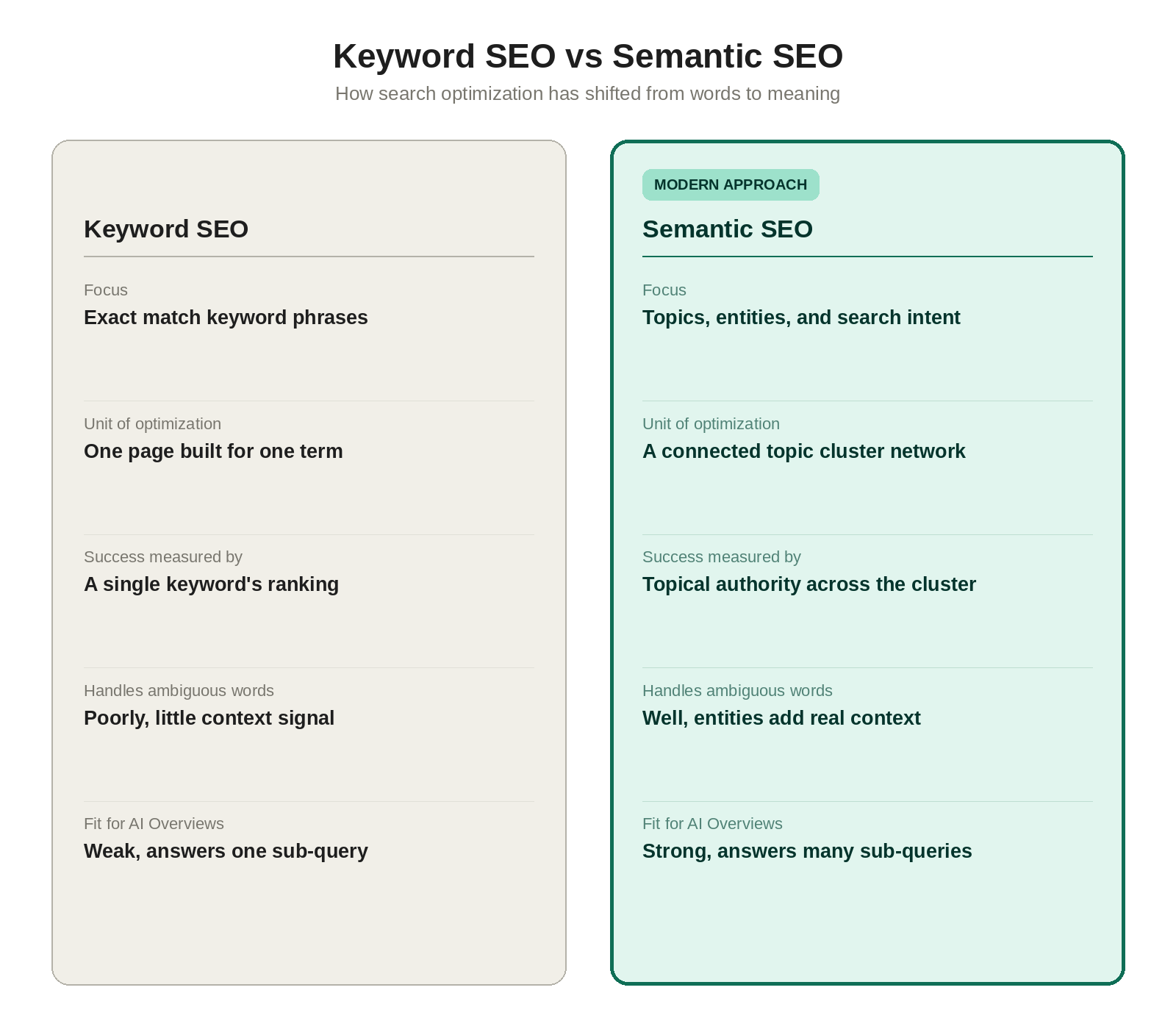
Understanding the process of semantic SEO becomes easier when it is compared with the older version.
The former type of SEO considers a web page to be a vehicle of a certain targeted keyword and success is measured in terms of ranking of that particular keyword. The latter does not do so. In the process of semantic SEO, topics as well as content clusters are mapped, and success is measured in terms of topical authority of the concept networks.
Think about the word "apple." A purely keyword driven page has no way to signal whether it means the fruit, the company, or a record label. Search engines that rely only on keyword matching struggle badly with this kind of ambiguity, which is exactly why context, entities, and relationships had to become the new foundation of search.
The Core Building Blocks of Semantic SEO
1. Entities
Entities are unique objects, which may be a person, a place, an organization, a product, or an idea, that the search engine can identify without being dependent on how they were described using words. Entities become clear through structured data. As one guide explains, schema gives search engines and AI systems clearer machine-readable context about entities, authors, organizations, products, and the relationships between them, which reduces the ambiguity that plain text alone often leaves behind.
2. Topical Authority and Content Clusters
Rather than just a single disconnected page, semantic SEO requires an interconnected body of content that explores a subject from every possible perspective. This approach is frequently referred to as building topical authority and accomplishes it by discussing all facets of the subject in question through the use of related subjects and synonymous terms.
3. Search Intent
When considering semantic SEO, one must remember that the purpose of the search should be matched, not the literal search phrase itself. If one were to write a page aimed at the comparison shopper versus the purchaser, both of whom use the same search keyword, the structures would be very different.
4. Structured Data and Schema Markup
Schema markup, most commonly written in JSON-LD, labels the visible content on a page so machines can interpret it accurately. It is worth being precise here, because there is some confusion in the industry. Google has been direct that structured data is not required for AI Overviews or AI Mode, and there is no special schema.org markup needed just for generative AI features. At the same time, Google has also said that structured data helps them understand content and gather information about entities like people, places, and organizations, and a controlled experiment by Search Engine Land found that a page with complete Article, FAQPage, and Breadcrumb schema appeared in a Google AI Overview while otherwise similar pages did not. The honest takeaway is that schema is not a requirement, but it is a meaningful advantage layered on top of genuinely helpful, well structured content.
5. Semantic HTML and Content Structure
Descriptive headings, clear question and answer sections, lists, and tables all help both readers and machines parse your content correctly. This structural clarity matters even outside Google. Microsoft's own AI search guidance recommends descriptive headings, question and answer formats, lists, tables, and schema markup to help AI systems interpret content.
How Semantic SEO Connects to AI Overviews and Generative Search
Vector embeddings are at the heart of how modern search actually decides relevance. In simple terms, the goal of semantic SEO is to get your content's embedding close to the embedding of a user's related queries in vector space, a mathematical representation of meaning rather than a literal string match.
This is particularly important for AI-generated answers, where the AI splits a question into multiple sub-questions before answering it. A page that only targets the main keyword answers a small percentage of the sub-questions raised. A page with full entity coverage answers many of the questions. In the analysis of AI Overview optimization, "content which covers the entire landscape of a topic, and does it all cohesively and not awkwardly, gets considered more authoritative than content that scratches the surface."
That is also why schema and structured data show up so often in AI search discussions. AI systems process enormous volumes of content and tend to prioritize sources that require the least interpretive work, and clean, well-labeled, entity-rich content is simply easier to extract and cite accurately.
How to Actually Implement Semantic SEO

SEO search engine optimization for modish e-commerce and online retail business showing on computer screen
By InfiniteFlow
Start with topic maps, not keyword lists. Find your key area of expertise, and then list down all the subtopics, questions, and entities associated with it before putting pen to paper.
Build content clusters around a pillar page. Make a single page covering the main topic and connect it to other pages which explore individual aspects of the main topic in depth. Internal linking is what will connect all these pages into a cluster.
Use related terms and entities naturally. Use synonyms, related ideas, and named entities as they occur naturally within the topic, and not just by repeating the same idea.
Answer real questions directly. Organize the sections according to how your audience asks the question because both People Also Ask and AI-generated content have an affinity for such structure.
Add accurate schema markup. Deploy the schema types Article, FAQPage, Organization, and Author only where they match your actual content. Schema won’t create rankings from nothing, but it eliminates friction that gets in the way of understanding what you’ve written.
Track topical performance, not just single keyword rankings. This is why semantic SEO success is judged on a full concept network and you should pay attention to the performance of your complete cluster, not just one page for one keyword.
The Bottom Line
Semantic SEO is not just another buzzword. This SEO technique shows the change that has been made in how language is processed by search engines and AI in general. Keywords do become an indicator of what users are looking for but are no longer the final goal of optimization. Content that contains comprehensive coverage of the topic and entities, as well as actual search intent and proper structuring, is what makes websites visible in search engine results and even in AI-driven answers on top of them.
Start by mapping your topics honestly, connect them with real internal linking, and write for the full breadth of what your audience wants to know. That is the strategy that holds up whether the result is a blue link or an AI Overview.
Sources
W3era: What Is Semantic SEO, A Complete Guide to Better Rankings
Niumatrix: Semantic SEO in 2026, A Complete Guide for Entity Based SEO
SEO Score Tools: Semantic SEO 2026, Entity Strategies Beyond Keywords
BabyLoveGrowth: What Is Semantic SEO, A 2026 Guide for Marketers
Search Engine Land: Entity-first SEO, How to Align Content with Google's Knowledge Graph
Trone: Schema Markup for AI Search, How to Improve Visibility in Google AI Overviews
Opace: Schema Markup for SEO, The Complete Structured Data Guide
ZipTie.dev: How to Use Schema Markup to Get Featured in AI Search
Medium (Olibro Design): Schema Markup for AI Search, Complete Guide