
Search isn't what it was even eighteen months ago. AI Overviews sit on top of the SERP, zero-click behavior is the norm rather than the exception, and "position tracking" alone can no longer tell you whether your SEO program is working. If you're still building reports around the same five metrics you used in 2022, you're probably reporting numbers that look good in a meeting but don't actually move the business.
This post takes a closer look at today’s important KPIs for SEO – those that aren’t vanity metrics, and those that you “may want to know” about, but instead, the key metrics that drive visibility, traffic and revenue through artificial intelligence.
SEO Metrics vs. SEO KPIs: Know the Difference
Before diving in, it's worth separating two terms people use interchangeably. A metric is any data point, like clicks, impressions, or average position. A KPI is a metric tied to a business outcome. "Average position" is a metric; "organic leads per month from non-branded keywords" is a KPI, not a metric.
Teams tend to focus on 20 to 30 metrics, yet in reality, they should be running the business with only three to seven key metrics. The idea is to exclude everything that makes sense in terms of a PowerPoint presentation but does not have anything to do with revenue, pipeline, and cost efficiency. Total page views and keywords are the two examples.
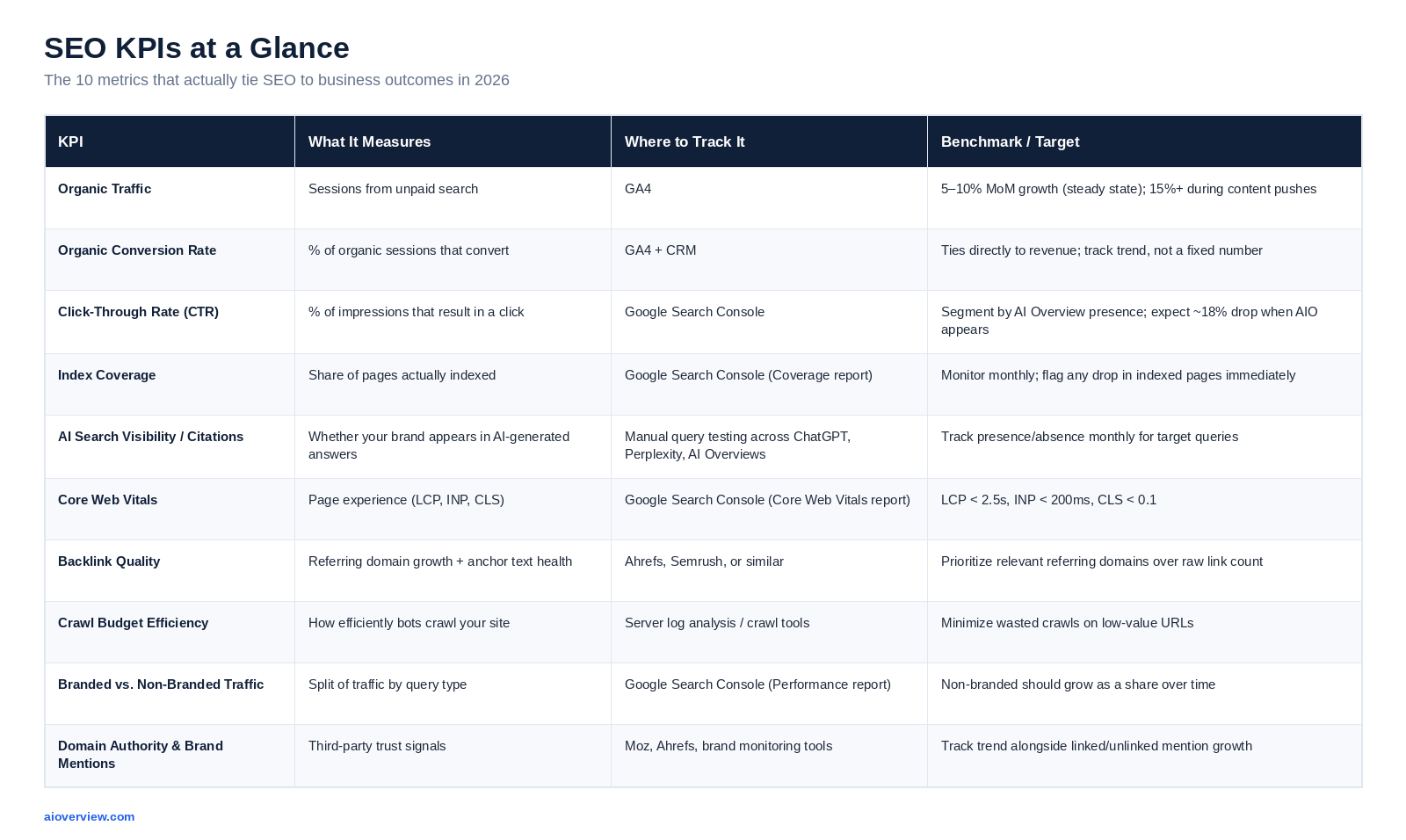
1. Organic Traffic (Still Foundational, But Not Enough Alone)
Organic traffic, meaning visitors landing on your site from unpaid search, remains the foundational SEO metric. Track it month-over-month and year-over-year, since SEO is seasonal in nearly every industry; a March traffic dip that looks alarming in isolation often matches the same dip from the prior year.
With GA4, use sessions with sessions engaged (sessions with visit time more than 10 seconds, session has an event or 2+ page views) to remove bot traffic and single-page visits. An optimal baseline is a 5%-10% increase per month when in steady state and above 15% when actively publishing content.
2. Organic Conversion Rate
Rankings and traffic with no conversions are vanity metrics. The KPI that truly measures the connection between SEO and revenue is the organic conversion rate. This metric must sit on top of the dashboard for 2026. If you see your organic sessions rising and your conversions stagnant, then your traffic isn't doing its job regardless of how impressive the rankings report.
3. Click-Through Rate (CTR): Pulled From Search Console, Not Estimates
CTR is the percentage of users who click your listing after seeing it in the SERP. Pull this from GSC rather than relying on generic estimated CTR curves, since actual click behavior now varies wildly by query type and whether an AI Overview is present.
That last part matters more than it used to. AI Overviews reduce CTR on average by 18%, but those clicks that remain perform 23% better in terms of conversion because the people visiting the page have read an overview and are looking for more information. Viewing the Click-Through Rate without considering the presence of AI Overview will lead you astray.
4. Index Coverage
This may seem like an obvious factor, but it’s the very foundation for all the others that follow on this list. Before any other statistic can come into play, your pages must first be indexed. The fact is that you’ll often discover quite a large proportion of your content sitting around “Discovered – currently not indexed,” and a decline in the number of indexed pages usually precedes a decline in traffic by a few weeks.
5. AI Search Visibility & AI Overview Citations

Analyst utilizing technology and dashboard with charts data science and Big Data technology for business, Strategic data management system with KPI organization performance with technology
By GamePixel
It is the latest addition to any serious SEO KPIs list, and quite possibly the single most significant structural change in this piece of writing. With increasing numbers of searches being launched in ChatGPT, Perplexity, or the AI Overviews from Google, getting mentioned in those AI-powered responses, even if it does not lead to a click, will be the new key visibility metric.
The magnitude of change cannot be understated. As of right now, something like 58–68% of searches do not result in users clicking through to any web page, and the figure rises to about 83% when there are AI Overviews present on the page. In a study conducted by Pew Research, users clicked on a cited source 1% of the time.
That doesn't mean the visibility is worthless; it means the value moved. Brands cited inside AI Overviews earn roughly 35% more organic clicks and 91% more paid clicks than non-cited brands on the same query, according to Seer Interactive. Track this by running target queries monthly across major AI platforms and logging whether, and how, your brand appears.
6. Core Web Vitals
It all comes back down to technical performance. Core Web Vitals measure Largest Contentful Paint (LCP), Interaction to Next Paint (INP), and Cumulative Layout Shift (CLS), encompassing loading performance, responsiveness, and visual stability. Poor or unstable websites harm user experience and negatively impact conversion rates, even if everything else looks good from ranking and traffic standpoint. It's simple to identify problematic templates through the Core Web Vitals report of Google Search Console.
7. Backlink Quality (Not Backlink Quantity)
Total backlink count alone do not provide any useful value. However, in KPI form, this metric shows the growth in referring domains which are related to the industry you belong to. Also, it helps spot the toxic growth in links which may be flagged by the algorithms. One more metric you can combine with this one is anchor text distribution.
8. Crawl Budget Efficiency
Rarely monitored, hugely important. For any big or complicated website, unproductive bot behavior will work quietly to keep your most valuable pages from getting indexed at all. And if your organization hasn’t yet considered how search bots navigate your site, then this is the single highest value-added place to begin.
9. Branded vs. Non-Branded Traffic
Splitting traffic this way tells you whether SEO is building new demand or simply capturing people who already knew your name. Growth concentrated entirely in branded search is a warning sign that your content isn't winning new audiences, even if the top-line traffic number looks healthy.
10. Domain Authority & Brand Mentions
Site authority now depends on more than backlinks alone. Domain authority and links from media or otherwise relevant sites, plus unlinked brand mentions, all factor into how the broader digital ecosystem perceives a brand. A domain with strong authority and trustworthy citations tends to rank better and hold its positions over time.
Building a Dashboard Around These KPIs
A common mistake is building a dashboard around whatever data is easiest to pull, then calling the result a KPI report. The correct order is the reverse: define KPIs first, then build the dashboard structure around them. A dashboard built around available data instead of target KPIs is how teams end up reporting metrics that don't matter.
Start with 5–7 core KPIs spanning visibility, traffic quality, conversions, and business impact. Add more only once your program has matured enough to actually act on the additional signals.
The Bottom Line
SEO in 2026 isn't measured by rankings and raw traffic anymore. Search is happening across Google's traditional results, AI Overviews, AI Mode, and chat-based assistants like ChatGPT and Perplexity, and your KPI stack needs to reflect that reality. Visibility, intent, and outcomes matter more than blue-link position alone. Track the metrics that predict revenue, drop the ones that only look good in a meeting, and build your reporting around AI-era visibility as seriously as you build it around clicks.
Sources
HubSpot – KPI in SEO: The Metrics That Actually Matter in 2026
Digital Applied – Zero-Click Search Statistics 2026: Complete Data Guide
Arfadia – Zero-Click Search Statistics 2026: Sourced & Updated
Bridgeway Digital – 12 SEO KPIs to Track in 2026: Metrics, Formulas & Benchmarks
MD Marketing Digital – SEO KPIs: Key Metrics to Measure Your Digital Strategy (2026)
SEO Sherpa – SEO KPIs: How to Track and Prove SEO Success in 2026