
Artificial intelligence is changing how people discover, research, and evaluate businesses. Instead of relying exclusively on traditional search engines, consumers are increasingly asking AI platforms questions about companies, products, services, and industry recommendations.
When someone asks an AI model which company offers the best solution, what a brand is known for, or whether a business is trustworthy, the response can influence their perception before they ever visit the company's website.
This makes understanding how AI models understand brands an important part of modern digital marketing.
AI models do not understand businesses in exactly the same way people do. They process patterns in language, information from training data, and, when available, information retrieved from external sources. The way a brand is described across the internet can influence how AI systems identify it, explain its services, and include it in relevant answers.
For businesses looking to improve their visibility in AI search, understanding this process is the first step toward building a stronger digital presence.
How AI Models Understand Brands
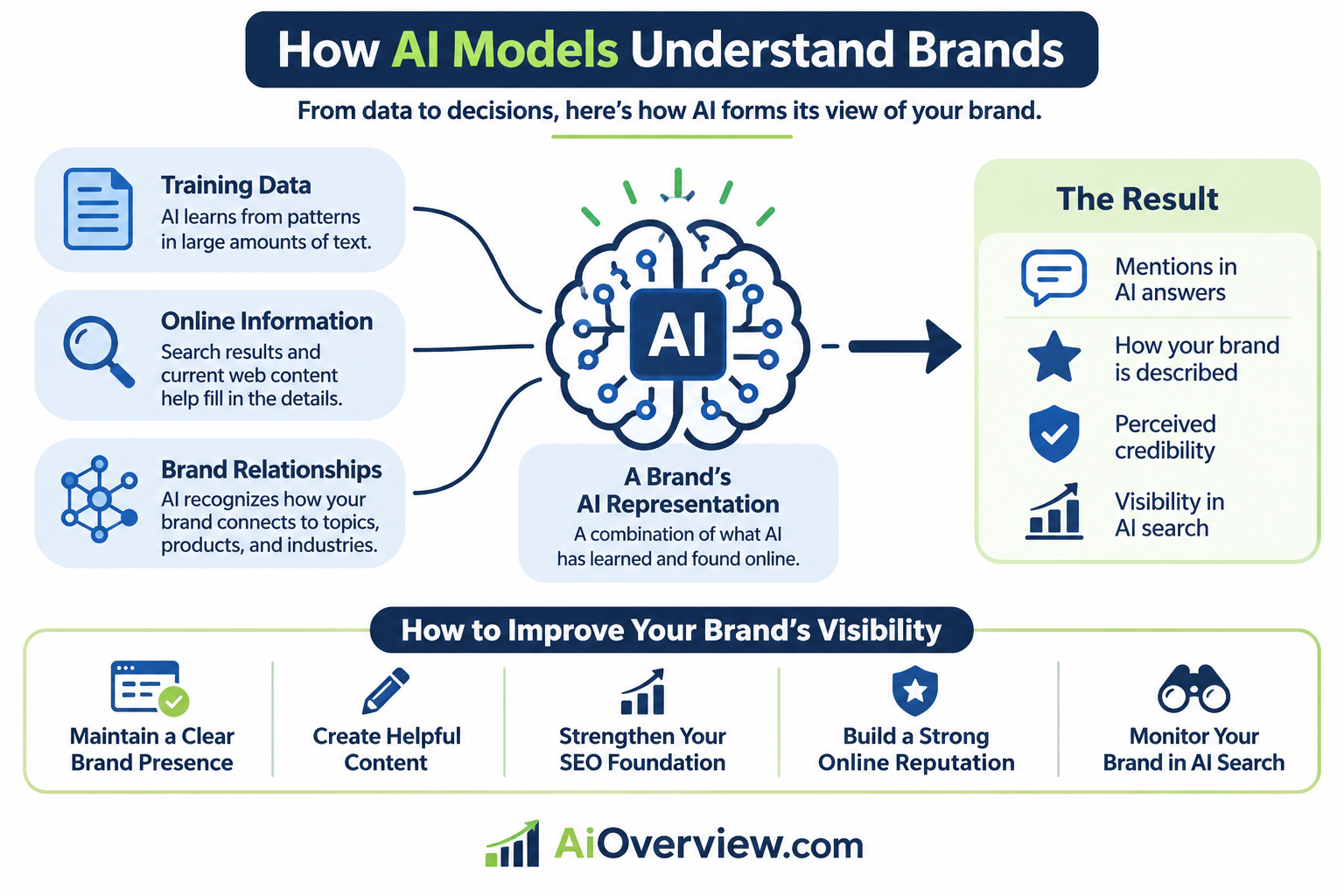
AI models develop representations of brands through the information and relationships they encounter.
During training, language models learn patterns from large collections of text. These patterns help models recognize names, concepts, relationships, and common associations between different topics.
For example, when a company is consistently described as a software provider specializing in cybersecurity, AI models may learn to associate that company with cybersecurity solutions.
However, a brand's representation is not necessarily a single, permanent definition. Different AI models may have different training data, knowledge, and ways of processing information.
When AI search tools retrieve information from the web, they may also use current sources to help answer questions about a brand.
According to Google's guidance on AI search, generative search experiences can use retrieval techniques to connect AI responses with relevant information from Google's Search index.
This means a brand's online presence can influence both what AI systems have learned and what information they retrieve when answering a question.
The Three Ways AI Models Build a Brand Representation
1. Training Data and Brand Associations
AI models learn from patterns in the data used during training. This information may include publicly available text, licensed content, and other data sources, depending on the model and its development process.
Through these patterns, models can develop associations between brands and topics.
For example, a business may become associated with:
A particular industry or category
Specific products or services
Common customer needs
Industry expertise
Brand characteristics
Frequently discussed strengths or concerns
These associations can influence how an AI model responds when a user asks about a company.
If a brand is consistently described in clear, relevant, and credible ways, its identity may be easier for AI systems to recognize.
However, training data is not a live database of every company's current information. A model's existing knowledge may be incomplete, outdated, or inaccurate.
2. Online Information and Search Retrieval
Search-based AI models can find up-to-date data in order to provide answers to queries.
It is particularly necessary if users ask questions regarding the latest news of the company, their products, services, or comparisons between brands.
For instance, there could be a request like this:
"Which are the top reputation management companies for doctors?"
The AI system performing search can look through websites, articles, industrial news, and other resources before giving an answer.
The Internet data will help the system understand what businesses are concerned here.
This is why traditional SEO remains important for AI visibility. Google's AI features documentation explains that existing SEO fundamentals continue to apply to AI Overviews and AI Mode.
A brand needs accessible, useful, and relevant information online to create opportunities for its content to be discovered.
3. Relationships Between Brands and Topics
AI models can identify relationships between concepts, companies, products, and industries.
A brand may be associated with a specific service because that relationship appears repeatedly across its website, industry publications, educational content, and other relevant sources.
These relationships help AI systems determine whether a company is relevant to a particular question.
For example, if a company provides financial software, its online content should clearly explain its financial software capabilities, intended customers, and the problems it solves.
When a business communicates its identity consistently, it gives search systems and AI models clearer information to work with.
Why Brand Consistency Matters in AI Search

Person using laptop with Ai Content Generator. Interaction with the Ai assistant to solve some tasks more easily. Image generator, documents, marketing and advertising, bot writing and coding. See Less
By Mer_Studio
A company's digital presence often includes multiple sources of information.
Its website may describe one set of services, social media profiles may emphasize another, and third-party articles may use different language to explain the brand.
When these descriptions are inconsistent, it can become more difficult for people and AI systems to develop a clear understanding of what the company does.
Brand consistency helps reinforce important information, including:
Company name and identity
Core products and services
Industry specialization
Target audience
Brand expertise
Business positioning
This does not mean every website or article should use identical wording. Instead, the information should communicate a consistent and accurate understanding of the business.
A clear brand identity makes it easier for potential customers to recognize what a company offers and why it may be relevant to their needs.
What Influences Whether AI Models Mention a Brand?
Being understood by an AI model does not automatically mean a company will be mentioned in every relevant answer.
AI-generated responses depend on the user's question, the model being used, the information available, and whether the system retrieves external sources.
Several factors can influence brand visibility.
Relevant Website Content
A company's website should clearly explain its products, services, expertise, and customer value.
Helpful content can answer questions that potential customers are likely to ask, such as:
What does this company do?
Who does it serve?
What problems does it solve?
What makes its services different?
How does its product work?
Google recommends creating unique, valuable content that provides meaningful information rather than simply repeating what already exists online. Its guide to generative AI search optimization emphasizes the importance of useful, original content.
Credible Brand Mentions
Information about a company may appear beyond its own website.
Industry publications, relevant business directories, customer reviews, professional discussions, and news articles can contribute to the broader online picture of a brand.
The quality and relevance of these mentions matter more than simply accumulating a large number of references.
Businesses should focus on earning authentic mentions through valuable work, useful content, customer experiences, and credible industry participation.
Clear Information About Products and Services
AI systems need information that helps connect a business with the questions users ask.
A company that provides several services should explain each one clearly.
For example, a reputation management company may offer review management, negative content removal, search suppression, digital PR, and AI search visibility services.
If these services are clearly explained throughout its website, visitors and AI search systems have more context about the company's capabilities.
Accurate and Helpful Content
AI-generated answers may rely on information from multiple sources. Businesses should make sure their own content is accurate, current, and easy to understand.
Outdated service descriptions, conflicting company information, or unsupported claims can create confusion.
Maintaining accurate information helps strengthen the overall quality of a brand's digital presence.
How to Improve Your Brand's Visibility Across AI Models
Understanding how AI models understand brands is useful, but businesses also need a practical strategy for improving visibility.
1. Establish a Clear Brand Identity
Start by reviewing how your company describes itself online.
Your website should clearly communicate your company name, industry, services, audience, and value proposition.
Make sure important information is easy to find and consistent across your website and business profiles.
2. Create Content That Answers Real Questions
Develop content around the questions your customers are already asking.
Educational articles, service pages, FAQs, industry insights, and detailed product explanations can help provide useful context about your business.
Focus on answering questions thoroughly rather than creating content solely to repeat keywords.
3. Strengthen Your Traditional SEO Foundation
AI search visibility is closely connected to the broader quality and accessibility of your online content.
Businesses should continue focusing on:
Search engine indexing
Clear website structure
Relevant internal links
Helpful page titles and headings
Accurate business information
Original and valuable content
Google's AI search documentation confirms that websites should continue following established SEO best practices to be eligible for visibility in AI-powered search experiences.
4. Build a Credible Digital Reputation
AI models may encounter information about your business through reviews, articles, online discussions, and other public sources.
A strong reputation can help reinforce the credibility of your brand.
Encourage authentic customer feedback, respond professionally to reviews, and address legitimate concerns.
Businesses should also monitor negative or inaccurate content that may affect how their company is perceived online.
5. Monitor How AI Platforms Describe Your Brand
One of the most important steps is understanding how your brand currently appears across AI platforms.
You may discover that an AI model:
Describes your company incorrectly
Does not mention an important service
Associates your brand with the wrong industry
Recommends competitors instead
Provides outdated information
Fails to recognize your company's expertise
These insights can help identify opportunities to improve your website content, brand messaging, and overall digital presence.
How AiOverview.com Helps Businesses Understand AI Brand Visibility
Understanding how AI models understand brands can be difficult without monitoring what they actually say about your company.
AiOverview.com helps businesses monitor their brand visibility across AI search platforms, including ChatGPT, Gemini, Claude, Perplexity, and Google AI Overviews.
Rather than relying on assumptions about how AI systems perceive a brand, businesses can use AI visibility insights to better understand their current positioning.
With AiOverview.com, companies can monitor important visibility metrics, including brand rankings, prompts where their business is mentioned, competitors cited instead, and gaps in AI search performance.
These insights can help businesses identify:
Which AI platforms mention their brand
Which questions and prompts generate brand mentions
Where competitors appear instead
Which services may be missing from AI-generated answers
Opportunities to strengthen online content and brand visibility
Monitoring these patterns provides a clearer picture of how a brand is represented across AI search experiences.
AI visibility is not a fixed ranking. Responses can vary depending on the platform, question, available sources, and other factors. Consistent monitoring can help businesses understand these variations and make more informed decisions about their digital strategy.
The Future of Brand Reputation Is AI Visibility
As AI-powered search continues to change how people discover businesses, brand visibility will increasingly depend on more than traditional search rankings.
Companies need to understand how their brand is described, what information is available about their services, and whether AI systems recognize their expertise.
A strong AI visibility strategy begins with a clear brand identity, helpful content, credible online mentions, and an ongoing understanding of how AI platforms represent the business.
Brands that take a proactive approach can identify gaps, improve the accuracy of their online information, and strengthen their opportunities to be included in relevant AI-generated answers.
Do you know how AI models understand your brand?
With AiOverview.com, you can monitor how your business appears across leading AI platforms, identify visibility gaps, and better understand where your brand stands in the evolving world of AI search.