Page one used to be the end game. But today, more and more searches come to a close with an answer created by AI appearing at the top of the page. And the brands mentioned in that AI answer are getting the recognition. If your content is not getting cited in those answers, you are completely out of sight during that crucial decision-making process.
This is why any marketing department needs an AI Search Visibility Strategy. This eBook explains what that is, why it’s critical, and how you can put it into practice with regard to AI Overviews, ChatGPT, Perplexity, and other answer engines.
What Is an AI Search Visibility Strategy?
The AI search visibility strategy is a method that aims at achieving visibility of one’s brand, products, or content through the AI responses. The target is no longer the position at which one would find their blue link, but rather being referenced in the responses given by the AI system. It relates closely to SEO but has a different target. Traditional SEO asks, “Would Google rank the page?” The AI visibility strategy questions, “When AI queries someone from my niche, would it reference me?” This is also referred to as Generative Engine Optimization (GEO) or Answer Engine Optimization (AEO).
Why AI Search Visibility Matters Now
When an AI summary appears, people click far less. A Pew Research Center study tracked the browsing of 900 U.S. adults in March 2025 and found that users clicked a traditional search result on just 8% of visits when an AI summary was shown, compared with 15% when there was none.
The links within the summary fared even worse by receiving clicks from just around 1% of the visits. The users were also more prone to terminate the search session after viewing the AI summary (26% against 16%). At that time, approximately 18% of the searches generated a summary and long searches that asked a question were the most common.
In essence, it is quite simple. If the answer appears on the results page, your brand should definitely appear there as well. Mentioning your brand within the summary has become a goal in itself.
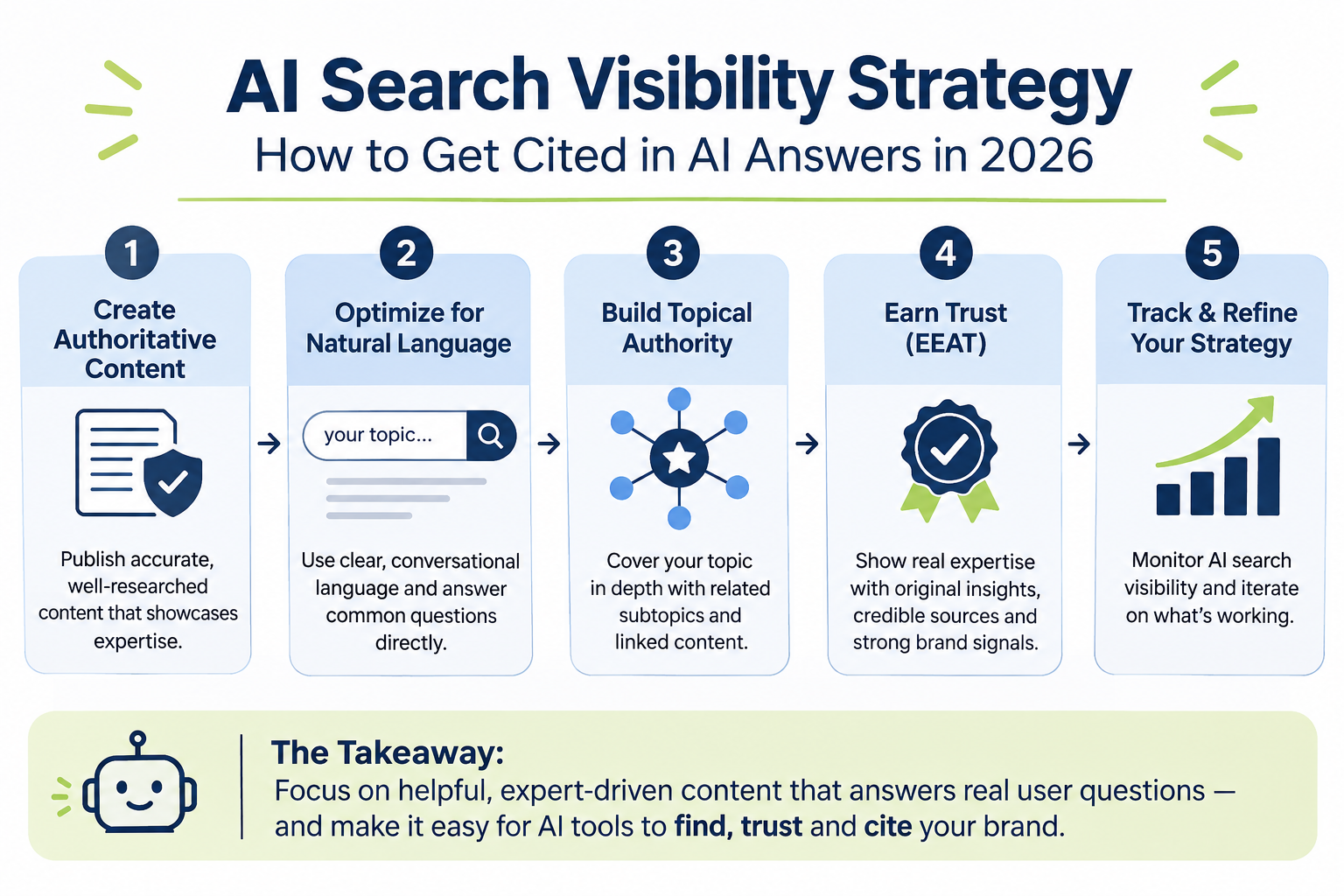
6 Steps to Build Your AI Search Visibility Strategy
The good news is that you do not need a secret playbook. Google's own guide to optimizing for generative AI features says its AI Overviews and AI Mode are built on the same core ranking and quality systems as regular Search. In other words, strong SEO is the foundation. Here is how to build on it.
1. Publish content AI cannot copy from everyone else
AI systems pull from many sources, so generic content blends into the crowd. Google draws a clear line between commodity content, like a basic list of tips anyone could write, and non-commodity content that offers first-hand experience or expert insight. Share original data, real customer stories, case studies, and opinions grounded in your own work. That is what earns a citation.
2. Answer the questions behind the question
AI search uses a technique Google calls query fan-out, where one question spawns several related searches behind the scenes. Someone asking how to improve AI search visibility might trigger follow-ups about tracking, content formats, and technical setup. Cover a topic thoroughly on strong, well-organized pages instead of spinning up thin pages for every keyword variation, which Google warns can violate its scaled content abuse policy.
3. Make your pages easy to crawl and understand
To appear in AI features, a page must be indexed and eligible to show a snippet. Check that crawlers are not blocked, important content is in plain text rather than hidden behind scripts, and pages load fast on every device. Use clear headings and short sections so both readers and machines can follow your logic.
4. Skip the hacks that do not work
A lot of AI visibility advice is noise. According to Google, you do not need an llms.txt file, special AI markup, content "chunking," or rewrites aimed purely at machines. Structured data is still useful for rich results, but it is not a ticket into AI Overviews. Put that time into better content instead.
5. Earn real mentions across the web
AI answers reflect what people say about you in reviews, forums, videos, and industry publications. Build genuine brand authority through PR, partnerships, and expert commentary. Manufactured or inauthentic mentions will not help, since the same spam systems that protect regular results also protect AI features.
6. Strengthen your visual, local, and product signals
AI responses can include images, videos, product listings, and local business details. Add high-quality visuals to key pages, keep your Google Business Profile current, and maintain accurate Merchant Center feeds if you sell online. Each one is another doorway into an AI answer.
How to Measure AI Search Visibility

AI with person using a laptop on a white table
By Tierney
You cannot improve what you do not track. Start with Google Search Console, which now offers a Generative AI performance report showing how people find your content through AI features in Search and Discover.
Beyond Google, run a simple monthly audit. Ask ChatGPT, Perplexity, Gemini, and AI Mode the questions your customers ask, then log the results:
Mention rate: How often your brand appears in answers for your core topics.
Citation rate: How often your pages are linked as a source.
Accuracy: Whether the AI describes your products, pricing, and positioning correctly.
Share of voice: How often you appear compared with your top competitors.
Traffic quality: Engagement and conversions from AI referrals, not just raw visits.
Be cautious with any tool that promises guaranteed AI rankings. Google notes that no third-party tool has access to its internal ranking or AI systems, so treat those tools as helpful dashboards, not crystal balls.
Start Building Your AI Search Visibility Strategy Today
AI search is not replacing SEO. It is raising the bar for it. The brands that win will be the ones with original insight, clean technical foundations, and a reputation people talk about across the web.
Pick one high-value topic this week. Audit how AI tools answer questions about it, find where your brand is missing, and publish the most useful, experience-backed page on the subject. Then measure, refine, and repeat. That is the heart of a strong AI search visibility strategy.
Sources
Pew Research Center, "Google users are less likely to click on links when an AI summary appears in the results" (July 22, 2025)
Google Search Central, "Optimizing your website for generative AI features on Google Search" (last updated July 10, 2026)