

Have you ever seen the tiny padlock symbol in your web browser? If yes, then you must have experienced the power of HTTPS. While most website owners are aware of how important HTTPS is, very few realize its actual purpose and what benefits it brings to them in terms of SEO as well as what can happen to them if they do not implement it. In short, using HTTPS is now non-negotiable.
What HTTPS Actually Does
HTTPS stands for Hypertext Transfer Protocol Secure. It's the encrypted version of HTTP, the protocol that governs how data travels between a user's browser and a web server. The "secure" part comes from TLS (Transport Layer Security), a cryptographic protocol that establishes an encrypted connection before any data is exchanged.
Are you familiar with the small padlock icon displayed in your web browser? Then you should be familiar with what HTTPS does for you. Even though most website owners know the importance of HTTPS, there is a small percentage of people who understand the true value of HTTPS and how it can benefit them through their SEO strategies, along with the consequences that come with ignoring HTTPS implementation. Anyone positioned between the user and the server, on a public Wi-Fi network, for example, can read it.
According to Google's Transparency Report, the vast majority of web traffic is now served over HTTPS, a dramatic shift from just a decade ago when encrypted connections were mostly reserved for banking and e-commerce sites.
The Security Case
The most fundamental reason to use HTTPS is protecting your users. A site without encryption exposes visitors to several real risks.
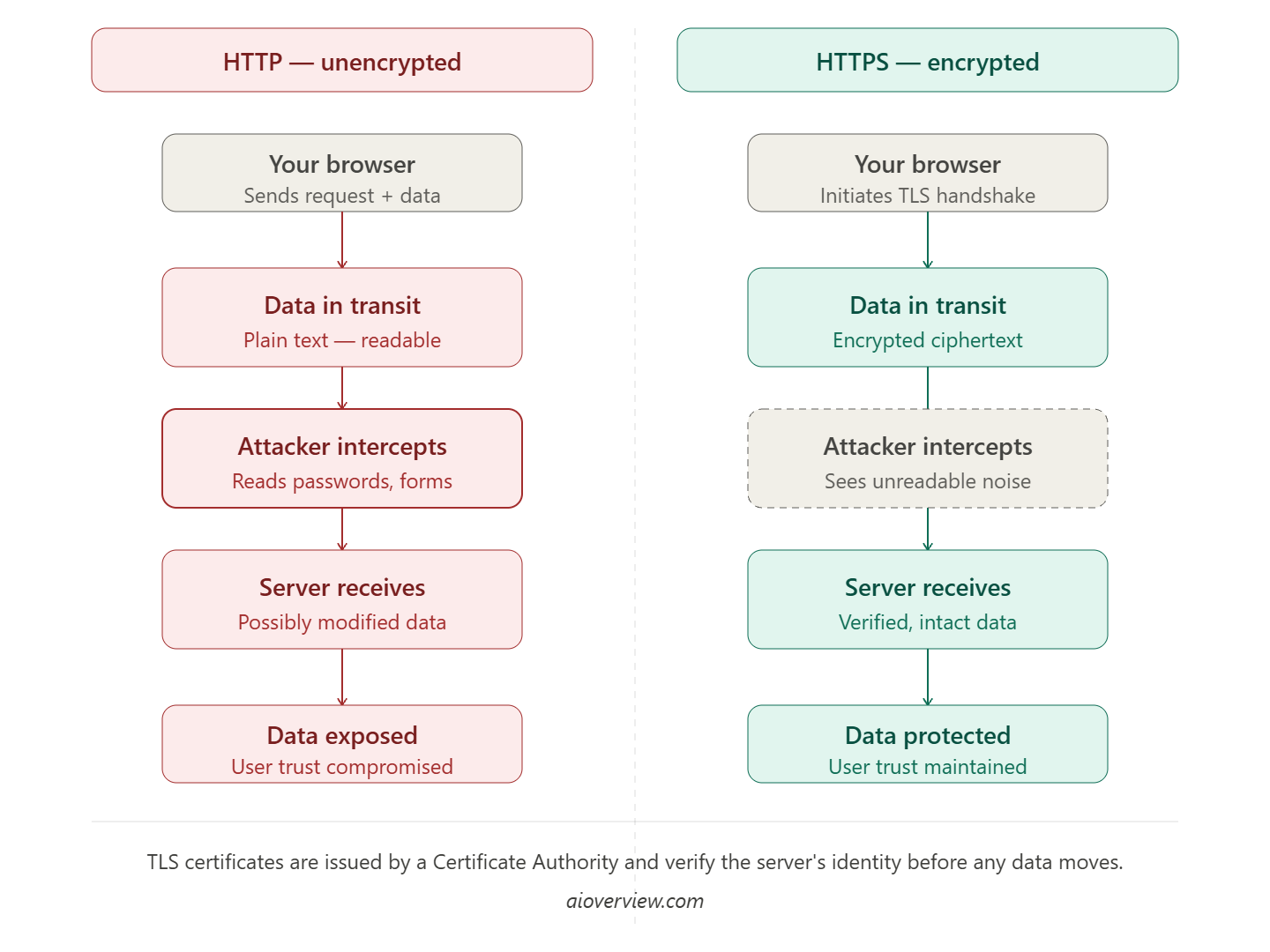
Man-in-the-middle attacks occur when a third party intercepts the connection between a browser and a server. When a web page is not encrypted, the attacker is capable of reading information submitted by users, embedding malicious code in webpages, or even directing them quietly to a phishing site. Using HTTPS makes sure that these attacks cannot be carried out because of a digital certificate and encrypting the channel before any data moves.
Data integrity is the second concern. Without encryption, page content can be modified in transit. Internet service providers and malicious actors have both been caught injecting ads and tracking scripts into unencrypted pages. HTTPS guarantees that what your server sends is exactly what the user receives.
For any site that handles user accounts, payments, or personal information, these protections aren't a nice-to-have. They're a legal and ethical obligation in many jurisdictions, including under the GDPR in Europe and various US state privacy laws.
The Trust Case
Security and trust are related but distinct. HTTPS signals credibility to users even when they don't fully understand the underlying technology.
It is no longer possible to disregard this particular message. The dominant browser today is Google Chrome, which occupies a vast market share in the world. It displays a red warning sign indicating that all HTTP pages are "Not Secure." Mozilla Firefox does exactly the same thing. You see this message before even going through a single word on your website. Studies done by the Baymard Institute prove time and again that security matters when making buying decisions and filling out forms.
Beyond the browser, HTTPS also validates that a website is who it claims to be. The TLS certificate underlying HTTPS is issued by a trusted Certificate Authority that has verified the domain's ownership. This is not foolproof, but it creates a meaningful baseline of accountability that plain HTTP cannot offer.
This is something that companies will face. Those who see the "Not Secure" sign will be more inclined to abandon the website right away, provide fewer details, and visit less frequently in the future.
The SEO Case
Google officially confirmed HTTPS as a ranking signal in 2014. At launch, it was described as a lightweight signal affecting a small percentage of queries. In the years since, its weight has grown as HTTPS adoption has become standard across the web.
The direct ranking benefit is real, but the indirect effects are arguably more significant.
Core Web Vitals and page experience signals, which are now part of Google's ranking framework, overlap with security. The pages that get loaded through HTTPS can benefit from HTTP/2, a more efficient version of the protocol that needs encryption on almost all web browsers. Multiple objects are transferred through one connection using HTTP/2 protocol, thereby lowering the load time for the page. The result is faster pages, hence better metrics.
Referral traffic data is another consideration that's easy to overlook. When a user clicks a link on an HTTPS site and lands on an HTTP page, the referral source is stripped from the analytics data. The visit registers as direct traffic, not as a referral. If you're trying to understand which channels drive traffic, running an unencrypted site silently corrupts that data.
The third indirect factor is that of safe browsing and malware warnings. The Google Safe Browsing tool actively searches for and warns against any malicious content on web pages. Web pages without HTTPS protocols are less secure and can easily have their content injected. As such, they are more prone to having malware warnings placed on them.
Getting HTTPS Right
Migrating from HTTP to HTTPS is not simply a matter of installing a certificate. A poorly executed migration can undo the SEO value you're trying to protect.
It is important that proper 301 redirects are set up from each and every HTTP link to its corresponding HTTPS link. Failure to do so would mean that there are effectively two websites for the same content – one hosted on HTTP and the other on HTTPS. This results in splitting of link equity, crawl budget, and ranking signals.
Free certificates through Let's Encrypt have removed cost as a barrier for most sites. Let's Encrypt is a nonprofit Certificate Authority that issues TLS certificates at no charge, with automated renewal. Most major hosting providers now support it natively.
After migration, verify your implementation using Search Console's Security Issues report and the URL Inspection tool. Check that mixed content warnings are resolved, meaning no HTTP resources like images, scripts, or stylesheets are loading on otherwise HTTPS pages. Mixed content degrades the security of an HTTPS page and can trigger browser warnings.
The last method of protection worth implementing would be HSTS (HTTP Strict Transport Security). This is simply a response header that tells browsers to always use HTTPS for your site, regardless of whether the user enters HTTP or not. More information about HSTS can be found in MDN's documentation on HSTS.
The Bottom Line
HTTPS is no longer merely a technical update reserved for high-profile websites or online stores. It's become an absolute necessity for every website wishing to secure its visitors, keep credibility within the browser and succeed in search engine results. The implementation costs nothing. The non-implementation cost, in terms of trust, traffic, and ranking, keeps rising.
If your site is still running on HTTP, there is no good reason to wait.
Sources
Google Transparency Report -- HTTPS encryption on the web
Google Search Central -- HTTPS as a ranking signal
Google Safe Browsing -- Safe Browsing overview
Let's Encrypt -- Free TLS certificates
MDN Web Docs -- Strict-Transport-Security header
MDN Web Docs -- Transport Layer Security
MDN Web Docs -- Mixed content
Baymard Institute -- HTTPS padlock and user trust
Ars Technica -- ISP ad injection on unencrypted pages
Google Search Central -- Core Web Vitals
Google Search Central -- Page experience signals
Google Search Central -- 301 redirects
Google Search Central -- Crawl budget management
Moz -- Referral data and HTTPS
Chromium Blog -- Chrome secure web announcement
Mozilla Security Blog -- Firefox HTTP warnings
Cloudflare -- What is an SSL certificate
OWASP -- Man-in-the-browser attack
CISA -- Securing your web browser
NCSL -- State digital privacy laws
Google Search Console -- Security Issues report